Micro-Retirement
/MY-kroh ri-TYRE-ment/noun
An intentional, temporary break from your main career to enjoy life before conventional retirement age, with plans to work again.
- #workplace slang
- #career breaks
- #work-life balance
- #burnout
Meaning
A micro-retirement is a deliberate break from your main career before conventional retirement age, usually lasting months and sometimes a year or longer, with an expectation of returning to work. People use the time to recover from burnout, travel, pursue personal projects or spend time with loved ones. The retirement label frames leisure as something to enjoy throughout life rather than postpone until its final working chapter. Some people plan repeated breaks, but a single break can also qualify in reported usage. It does not necessarily mean financial independence or an end to all paid work: someone may leave a demanding career and earn money through part-time work while pursuing other interests.[1][3]
- 1. A substantial, planned career break for rest or personal pursuits, followed by a return to work. This is the central sense documented in workplace reporting.
- 2. As a lifestyle goal, one of several breaks spread across a working life. This emphasizes taking portions of retirement-style freedom along the way; repetition is an aspiration, not a requirement of every use.
Examples
“I'm saving for a six-month micro-retirement before my next role.”
“My micro-retirement plan is mostly hiking, reading and sleeping properly.”
“During my micro-retirement from consulting, I'll work two café shifts a week.”
“We want to take a micro-retirement every few years, if we can afford it.”
Origin and spread
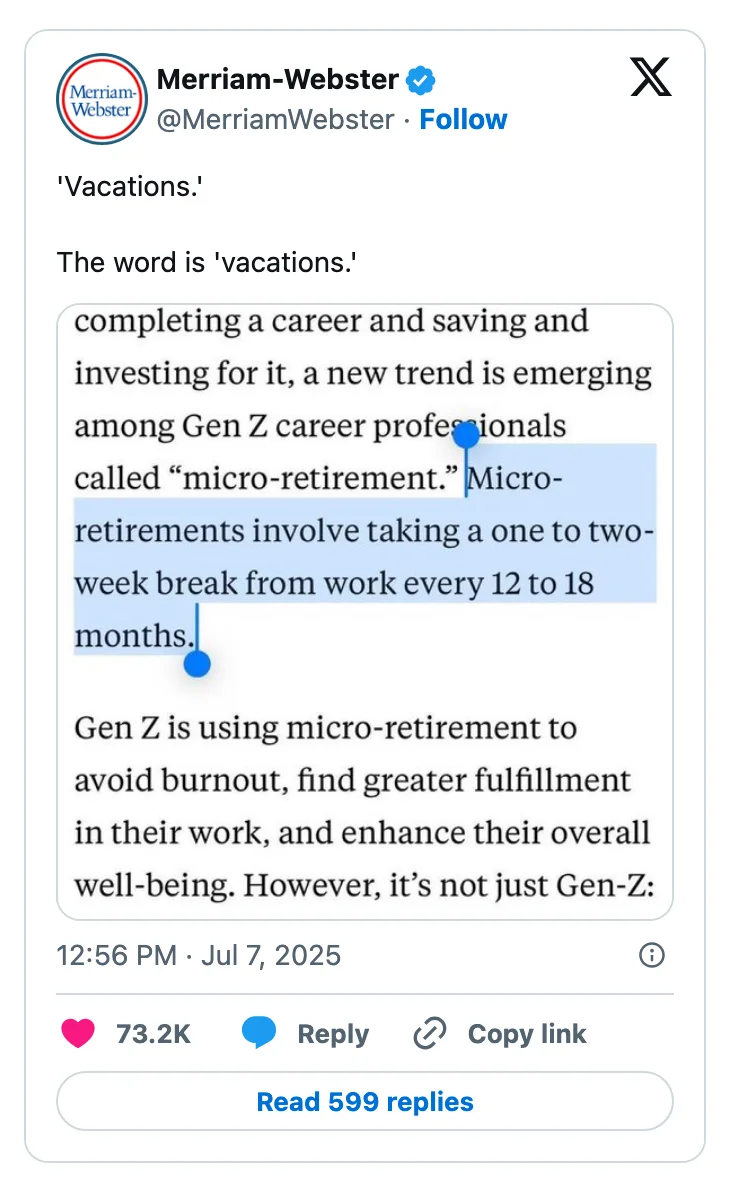
Earliest use not established. The documented conceptual lineage runs through mini-retirement: The Cut credits Tim Ferriss's 2007 book The 4-Hour Workweek with popularizing that expression. This supports the history of mini-retirement without establishing who coined the exact wording micro-retirement. By August 8, 2024, The Cut was reporting on mini-retirement discussions on TikTok. Its examples included a teacher saving toward a year off after three years of work and a London-based engineer describing breaks dotted throughout life. The article also interviewed people planning or taking substantial career breaks, including Brittany Foley, who left consulting to write a book and later worked part time in a restaurant. Business Insider explicitly used micro-retirement in its December 31, 2024 reporting, defining it as a career break lasting months or even years and identifying mini-retirement as another name. The expression was therefore documented before the 2025 coverage that framed it around Gen Z. A separate burst of discussion in July 2025 involved a much shorter definition. BuzzFeed reported reactions to Fast Company wording describing one to two weeks off every 12 to 18 months, then reported that the wording had been changed. The vacation jokes attached to that short-break definition help explain the backlash without redefining the months-long career break described elsewhere.[2][4]
How to use it
Use micro-retirement when you want to emphasize a deliberate period away from your main career and the choice to enjoy life before old age. The tone is often earnest or aspirational, though critics may use it sarcastically as workplace jargon. Give a duration when clarity matters: a six-month micro-retirement communicates something different from ordinary annual leave. The label alone says nothing definite about savings, employer approval, a guaranteed job afterward or whether someone continues earning money.
Why the vacation jokes need context
BuzzFeed quoted Reddit and X reactions to a definition involving only one or two weeks off every 12 to 18 months. One quoted commenter called that simply a vacation. The inspected Merriam-Webster post likewise says, “The word is 'vacations.'” These reactions target the circulated short-break definition, rather than demonstrating that a months-long career break is ordinary holiday leave.[4][1]
Trend coverage does not count participants
The expression appears in workplace reporting and accounts of TikTok discussion, but that does not establish how many people actually take these breaks. Maeve Toohey's RTÉ analysis explicitly acknowledged a lack of empirical evidence while discussing an apparent increase in participation.[5][2]
Questions people ask
Can you still earn money during a micro-retirement?
Yes. The break can be from your main career rather than every kind of paid work. The Cut profiled Brittany Foley leaving consulting to write a book and later taking part-time restaurant work. Business Insider included her experience in its micro-retirement coverage. The label therefore does not guarantee that someone is living entirely on savings.[2][1]
How is micro-retirement different from a sabbatical?
The terms overlap substantially. Micro-retirement emphasizes enjoying life before old age and can suggest repeating breaks throughout a career. Erin Lowry's CNA commentary describes it as self-funded time without a guaranteed job on return, while The Cut discusses several arrangements, including employer sabbaticals and breaks between jobs. Check the actual arrangement rather than assuming the label guarantees paid leave or a position afterward.[3][2]
Does taking micro-retirements mean giving up on conventional retirement?
No. Planning temporary breaks does not itself tell you whether someone is saving for old age. The Cut describes a teacher saving for a mini-retirement in a high-yield savings account while also contributing to a regular retirement plan. Temporary leisure and long-term retirement saving can be separate goals.[2]
Sources
- 1. Business Insider — What Is Micro-Retirement and How Can It Help With Burnout?Supports: meaning, earliest documented use.
- 2. The Cut — Meet the 20-Somethings Taking Mini-RetirementsSupports: origin.
- 3. CNA / Bloomberg Opinion — Gen Z Is Taking 'Micro-Retirement'. Don’t LaughSupports: meaning.
- 4. BuzzFeed — Micro-Retirement Is Going Viral, And People Aren't HappySupports: origin.
- 5. RTÉ Brainstorm — Why Micro-Retirement Has Become a New Workplace Trend for Gen Z & Millennials