Sealioning
/SEE-ly-un-ing/noun · verb
Sealioning is persistent, intrusive questioning that performs polite curiosity while wearing someone down or provoking them.
- #internet slang
- #online debate
- #trolling
- #Wondermark
Meaning
Sealioning is a form of trolling in which someone persistently demands answers, evidence or debate while presenting themselves as polite and sincerely curious. The pattern can include ignoring answers, repeating questions and continuing after someone asks to stop. If the target becomes irritated, the questioner treats that reaction as proof that the target is unreasonable or their position is weak. Calling someone a sealion therefore accuses them of bad-faith engagement. A request for evidence, even a challenging one, does not establish sealioning by itself: the surrounding pattern matters.[2]
- 1. In online discussions: repeated questions or demands for sources that keep someone trapped in an unwanted debate, under an appearance of civility.
- 2. By extension, in offline interactions: the same pattern of intrusive, polite-seeming questioning. This is an application of the same meaning, not a separate sense.
Examples
“I've answered that twice and asked you to stop. This is sealioning.”
“Asking for a source isn't automatically sealioning.”
“The sealioning continued in my messages after I left the thread.”
“At dinner, the sealioning carried on after three explanations and a request to change the subject.”
Origin and spread
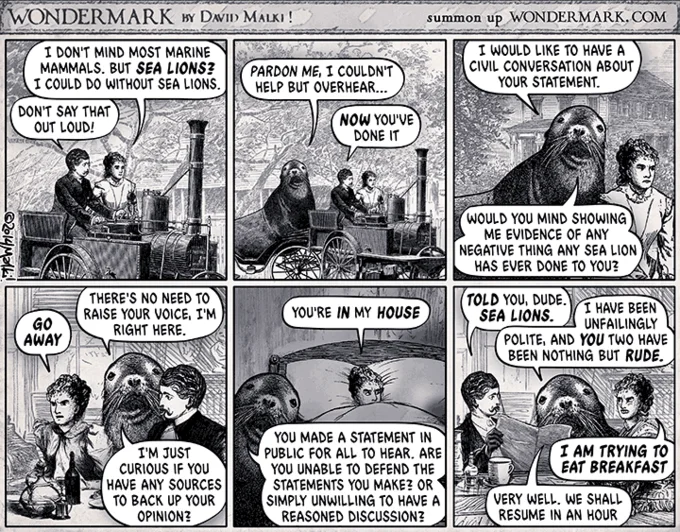
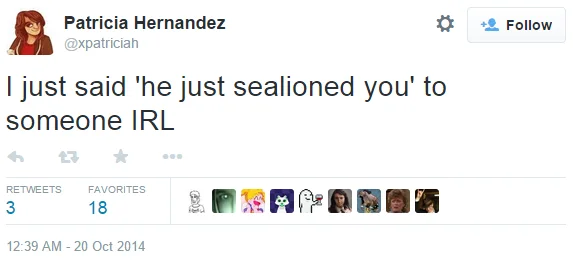
The reference comes from David Malki’s Wondermark comic “The Terrible Sea Lion,” published on September 19, 2014. A woman says she dislikes sea lions; a sea lion challenges her, follows her into private settings and keeps demanding justification while insisting on its own politeness. The mismatch between courteous language and intrusive pursuit supplies the metaphor. Know Your Meme connects early circulation to arguments surrounding GamerGate and reports an October 9, 2014 Reddit post titled “New term for GG behaviour – Sealioning?” Malki’s October 23 follow-up, ““Sea Lion” Has Been Verbed,” directly preserves contemporary uptake, including Patricia Hernandez’s October 20 post saying she had used “sealioned” about an offline interaction. It also records people disputing whether the comic fairly represented their behavior. Earliest use not established. These records document the expression’s circulation in October 2014; the comic’s publication date does not establish the first use of the verb or identify its coiner.[1][3]
How to use it
This is a critical accusation, not a neutral synonym for asking questions. To explain why you are using it, point to observable behavior: an answer repeatedly ignored, the same demand renewed or a request to stop disregarded. Polite wording alone cannot distinguish sincere inquiry from sealioning, and disagreement alone does not establish bad faith. The expression is usually applied online, but documented early usage also extends it to face-to-face interactions.
Why some readers sympathize with the sea lion
In Language Log’s comments, VVOV argues that the animal responds to a prejudicial remark, making the comic an imperfect match for the later slang. Kenny Easwaran emphasizes a different detail: overlooking the sea lion’s appearances in private locations can make it seem sympathetic. Their disagreement highlights how the initial remark and the subsequent pursuit invite different readings.[3]
The comparison was disputed from the start
Malki’s follow-up preserves Ferrett Steinmetz’s October 3, 2014 account of sending the comic to someone who continued commenting after he said he did not want to argue. According to Steinmetz, the recipient said it did not apply. This documents an early dispute over the comparison, rather than an established use of the new verb on that date.[4]
Questions people ask
How can I distinguish sealioning from an honest request for evidence?
Look at how the exchange develops. Does the questioner engage with answers, or simply renew demands and prolong the discussion? Do they respect a request to stop? Dictionary.com describes relentless questioning that continues regardless of a response and may follow someone across platforms. Those patterns support the accusation more than a single difficult question does.[2]
Did David Malki invent the word?
Malki created the comic that supplied the reference. His October 23, 2014 follow-up records other people already using the resulting verb, while Know Your Meme reports an October 9 proposal on Reddit. The supplied evidence establishes the connection to his comic, but does not identify an individual coiner.[1][4]
How is sealioning different from trolling?
Trolling is the broader category. Sealioning names a particular method: persistent questions or evidence demands presented as reasonable debate, with the target’s eventual irritation used against them. Dictionary.com describes both the polite-seeming presentation and the attempt to portray the questioner as the victim.[2]
Sources
- 1. Know Your Meme — Sea-LioningSupports: origin.
- 2. Dictionary.com — sealioningSupports: meaning, form.
- 3. Language Log — TIL: “Sealioning” and reader discussionSupports: origin.
- 4. Wondermark — “Sea Lion” Has Been VerbedSupports: form, earliest documented use.