Soft Life
/sawft lyfe/noun phrase
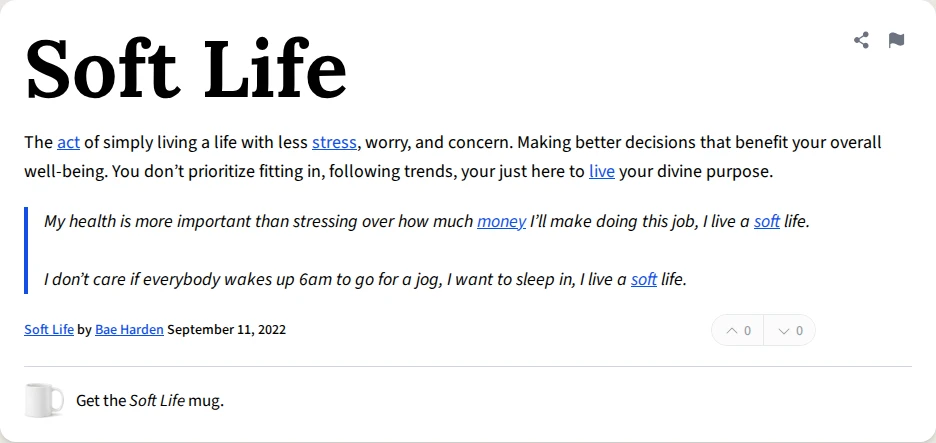
Soft life means prioritizing ease, peace and well-being over constant struggle, whether through everyday boundaries, restful moments or luxury.
- #soft life
- #Black internet culture
- #self-care
- #hustle culture
Meaning
Soft life is an aspirational way of living that puts peace, enjoyment and physical or emotional well-being ahead of constant struggle. In captions and #softlife posts, it can mean setting work boundaries, resting without guilt, enjoying supportive relationships or indulging in expensive comforts. It can also celebrate one peaceful afternoon rather than describe someone's entire circumstances. Luxury is one interpretation, but wealth, quitting work and financial support from a partner are not requirements of the expression.[3][4][5][6]
- 1. As a lifestyle or aspiration: choosing boundaries, rest, support and enjoyment instead of treating exhaustion or self-sacrifice as the price of success.
- 2. In a caption or hashtag: celebrating a comfortable moment, from a quiet breakfast to a lavish holiday, without necessarily claiming that the rest of life is stress-free.
Examples
“Laptop closed at five. I'm choosing the soft life.”
“Fresh sheets, no alarm, nowhere to be. Soft life.”
“I want a soft life: meaningful work, good friends and time to enjoy both.”
“Room service by the sea? This is my soft life weekend.”
Origin and spread
Earliest use not established. Dictionary.com reproduces an October 13, 2020 tweet by @dustytheestalli that explicitly connects #SoftLife with life being easy and free of stress. That documents the online sense by that date through a secondary reproduction; it does not identify the first use. The phrase itself predates the internet trend. Its contemporary cultural framing is associated with Nigerian influencers and Black women's conversations about ease, care and freedom from continual struggle. Stylist's October 2022 reporting places its origins in Nigeria and describes its popularization among African American women in opposition to hustle and girlboss culture. Fortune likewise attributes the idea to Nigerian influencers, without naming an originating post or inventor. By 2022, the expression was clearly documented as a TikTok trend. Stylist discussed a Simply Sayo spoken-word clip shared that April alongside interviews about work boundaries, personal choice and enjoying comfort. Luxury imagery and everyday approaches to well-being appear together in the coverage, rather than forming a proven sequence of separate meanings. In her 2023 Los Angeles Times essay, Rachel Cargle connected the conversation to longer Black traditions of seeking rest and care; those precedents provide cultural context rather than a date for the modern expression.[2][4]
How to use it
Use living the soft life, wanting a soft life or #softlife to express comfort, aspiration or a choice to protect your peace. A caption may playfully magnify a small pleasure. Read the surrounding post before assuming it describes wealth or employment status: the same phrase can accompany a luxury trip or an evening free of work messages. Its association with Black women carries a specific argument for rest, support and vulnerability in response to expectations of continual strength and self-sacrifice.
Why a soft life post can be mistaken for showing off
Stylist's interviewee Leanne Wright says people call her bougie for enjoying nice dinners and occasional spending. She also describes boundaries as a more important part of her soft life. Her account shows how visible purchases can draw attention away from the less photogenic choices behind the expression.[2]
Soft life and Black Girl Luxury overlap
Luxury purchases and lavish holidays fit one version of soft life. Fortune's interviewees emphasize that the idea also includes saying no at work, resting and building supportive community. Cargle similarly describes a spectrum from expensive comforts to boundaries and everyday pleasures, so the two labels are not interchangeable.[4][3]
Is soft life the same as slow living?
The ideas overlap, but slow-living author Stephanie O'Dea offers a distinction in Nice News: soft living can be a retreat after exhaustion, while slow living deliberately arranges life to help prevent burnout. This is her interpretive framework, rather than a fixed rule for how every caption uses either phrase.[5]
Questions people ask
Does living a soft life mean quitting work or having someone pay your bills?
Neither is required by the expression. Stylist profiles one woman who left her nine-to-five and another who works as a project manager. Fortune's interviewees describe practical choices such as setting limits at work and resting. The phrase alone does not tell you how someone earns money or who supports them.[2][4]
Why is soft life especially associated with Black women?
The coverage connects it to rejecting the expectation that Black women must always be resilient, self-contained and self-sacrificing. Fortune's interviewees frame softness as permission to receive care and be vulnerable. Cargle places that desire within a longer conversation about Black women's right to rest and live well.[4][3]
Did Nigerian influencers invent soft life?
They are credited in accounts of the trend's development, but these sources do not establish an inventor or first Nigerian post. Stylist places the expression's origins in Nigeria, while Fortune says it is believed to have originated among Nigerian influencers. Dictionary.com reproduces a clear #SoftLife tweet dated October 13, 2020, which documents use rather than invention.[2][4][1]
Sources
- 1. Dictionary.com — soft lifeSupports: earliest documented use, form.
- 2. Stylist — How the “soft life” trend is helping Black women ditch hardship in favour of happinessSupports: origin.
- 3. Los Angeles Times — Rachel Cargle on the soft life and Black women's access to easeSupports: meaning.
- 4. Fortune — Black women are embracing the soft lifeSupports: origin, meaning.
- 5. Nice News — Are You Embracing a “Soft Life”?Supports: meaning.
- 6. Urban Dictionary — Soft LifeSupports: meaning.