Clout Chasing
/klout CHAY-sing/noun · verb phrase
Clout chasing means seeking attention, influence, or fame in ways the speaker considers opportunistic, insincere, or desperate.
- #internet slang
- #social media fame
- #self-promotion
- #online drama
Meaning
Clout chasing is the pursuit of attention, popularity, influence, or fame through behavior the speaker considers opportunistic or desperate. It can involve manufacturing drama, exploiting a connection to someone famous, or joining a controversy mainly to attract followers. A clout chaser is someone accused of doing this. The expression adds a judgment about someone's methods or motives: wanting an audience alone does not establish clout chasing, and the accusation does not prove that attention was the person's real goal. It usually functions as criticism, though friends may use it teasingly and people may apply it to themselves as a joke.[1][2]
- 1. As criticism: seeking visibility through supposedly insincere or desperate tactics, such as picking a public fight with a more famous creator.
- 2. In playful use: teasing someone, or joking about yourself, for making an obvious bid for attention. This uses the same underlying meaning with a lighter tone.
Examples
“Starting another fake feud for views? That's clout chasing.”
“This staged selfie is my attempt at clout chasing.”
“Inventing a scandal to promote your work looks like clout chasing.”
“Picking fights with bigger creators just to gain followers is clout chasing.”
Origin and spread
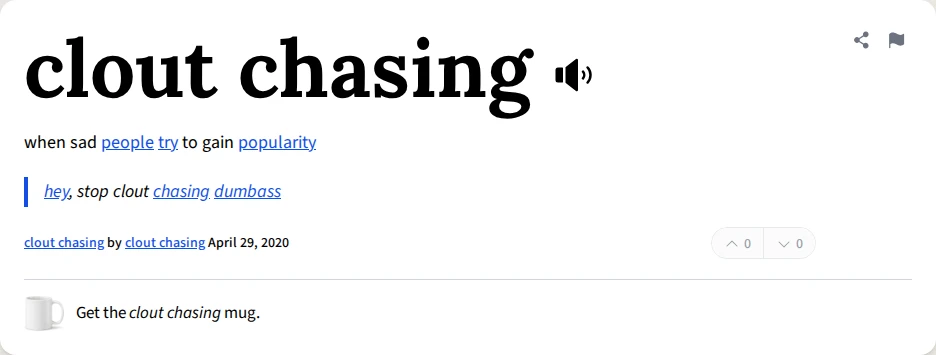
Earliest use not established. The related person-label clout chaser is directly documented in a June 4, 2012 post by @1domjulio: “I cannot take you serious if you a clout chaser!” It clearly expresses disapproval, although it does not explain the behavior being criticized. Dictionary.com describes the expression as emerging on social media around 2012; that account and the surviving post establish circulation, not a creator or place of invention. The supplied Urban Dictionary page also contains a September 12, 2017 entry for the exact phrase clout chasing, defining it through an attention-seeking feud with someone more popular. This documents the activity phrase by that date, without establishing that 2017 was its breakthrough year. In an April 16, 2018 post, musician SwuM praised artists growing their audiences organically and contrasted that with buying followers or being a clout chaser. Together, these records show the expression being used to question the authenticity of someone's pursuit of popularity. Mental Floss also describes contemporary teasing and joking self-description, but the evidence does not date the beginning of that usage.[4]
How to use it
Use clout chasing for the activity and clout chaser for the person accused of it: “That's clout chasing” and “He's a clout chaser.” The label usually sounds dismissive because it questions sincerity. Ordinary networking, promoting work, or joining a trend can attract attention without automatically deserving the accusation. Among friends, or in a knowingly staged selfie caption, the expression can be playful; directed at someone in a dispute, it is more likely to read as an insult.
An accusation that can undermine credibility
In the June 2012 post, @1domjulio explicitly says a clout chaser is someone they cannot take seriously. That is one person's stated reaction, and it shows how the label can dismiss someone's credibility as well as criticize their desire for fame.[3]
An influencer is not automatically a clout chaser
Dictionary.com distinguishes influencer, a typically neutral label for a role, from clout chaser, a critical judgment. The same person could receive both labels, but calling someone an influencer does not itself accuse them of desperate or insincere behavior.[1]
The criticism also applies to audience-building tactics
SwuM's 2018 post praises organic audience growth while contrasting it with buying followers or being a clout chaser. This places the expression in a concrete debate about how artists build an audience, beyond celebrity connections and public feuds.[4]
Questions people ask
What makes something clout chasing rather than ordinary self-promotion?
The accusation adds a negative interpretation of the method or motive. Sharing your work can be ordinary promotion; manufacturing a feud or exploiting a famous connection for visibility can invite the label. Mental Floss explicitly acknowledges that some people being judged online are genuinely networking or promoting themselves, so the label remains an assessment rather than proof.[1][2]
Does clout chasing date to 2017?
The exact activity phrase appears in an Urban Dictionary entry dated September 12, 2017, but the related label clout chaser survives in a June 4, 2012 social post. Neither record establishes invention, and a dated dictionary submission does not demonstrate when an expression became popular.[5][3]
Can you call yourself a clout chaser as a joke?
Yes. Mental Floss describes people joking about their own bids for attention, including a staged photo captioned with clout chasing. That makes playful self-description a supported use, although the expression still carries a critical edge when aimed at someone else.[2]
Sources
- 1. Dictionary.com — clout chaserSupports: meaning.
- 2. Mental Floss — What Is “Clout Chasing?”Supports: meaning.
- 3. X — @1domjulio's June 4, 2012 postSupports: earliest documented use.
- 4. X — SwuM's April 16, 2018 postSupports: origin.
- 5. Urban Dictionary — Clout ChasingSupports: earliest documented use.