content farming
/KON-tent FAR-ming/noun
Producing large volumes of online material aimed at traffic, often with little added value.
- #web publishing
- #search
- #platforms
Meaning
Content farming is producing a large volume of online material mainly to capture traffic or attention. A content farm might commission many cheap answers to popular searches, or keep repackaging similar posts because each one can earn another click. The term usually criticizes the production incentives and the usefulness of the output.
- 1. Large-scale production of articles designed around common search queries and advertising traffic.
- 2. A criticism of repetitive or thin social posts made mainly for clicks, views or platform rewards.
Examples
“The channel's daily clones started to feel like content farming.”
“We talked about content farming when every answer page repeated the same three lines.”
“The editor wanted a reporting plan before the template became content farming.”
“Content farming made the search results look comprehensive until I opened them.”
Origin and spread
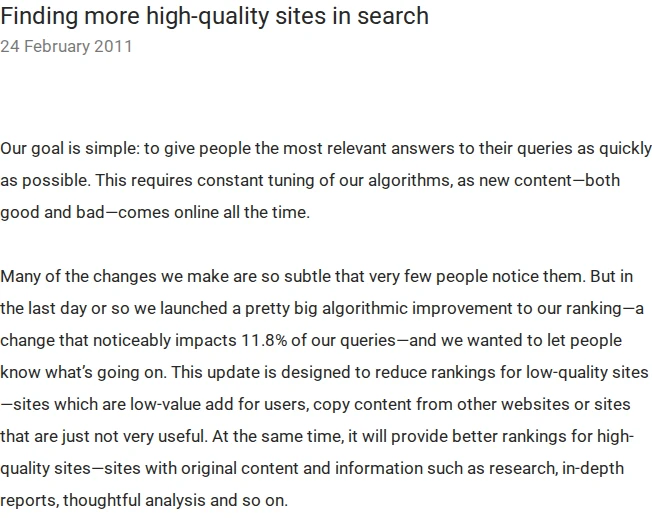
Discussion of content farms intensified around 2010 and 2011 as publishers produced large numbers of pages for popular search queries. WIRED covered Google's 2011 response to low-quality search results. The same criticism can be applied to newer feeds and formats, where repeated production aims at attention rather than search traffic alone.
How to use it
High output by itself tells you little. The label fits when production follows traffic opportunities and many resulting pieces offer little new work to the reader.
Why search rankings mattered
Large-scale publishers could build pages for many separate search queries. A ranking change could affect the traffic of numerous pages at once.[1][2][3]
Production model and platform response
Content farms describe how material was produced. Google's announcement describes a search-ranking response to perceived low quality.[1][3]
Questions people ask
Does every high-volume site count as a content farm?
The criticism concerns the reason for the volume and the usefulness of what is produced. High volume alone is insufficient.[1]
Is content farming just clickbait?
Clickbait describes a lure, often in a headline or thumbnail. Content farming describes the wider way many pieces are produced.[2]