Facepalm
/FAYSS-pahm/noun · verb · interjection
Facepalm is an online reaction expressing embarrassment, dismay, exasperation, or disbelief, often in response to a mistake or foolish remark.
- #internet slang
- #reaction text
- #emoji
- #online gestures
- #meme history
Meaning
Online, facepalm names the gesture of bringing a hand or hands to the face and serves as a text or visual reaction. It can express embarrassment, annoyance, disappointment, dismay, frustration, or disbelief; a mistake or perceived lapse is a common context, not a requirement. The word can appear alone, between asterisks or brackets, or as a verb, as in facepalmed. It may be playful or self-mocking, while directed at another person it can imply that their action or remark was foolish.[1][2][3]
- 1. As a reaction, facepalm expresses embarrassment, annoyance, disappointment, dismay, frustration, or disbelief. A mistake or perceived lapse in judgment is a common context, but the reaction is not limited to one.
- 2. As a verb, to facepalm means to bring a hand or hands to the face as a reaction; facepalmed is the ordinary past-tense form.
- 3. In online messages and media, facepalm can be written between asterisks or brackets, or represented by an emoji, GIF, video, or reaction image. The Picard image is one recognizable example, not the whole expression.

Examples
“I sent the draft without the attachment. Facepalm.”
“*facepalm* I forgot to check the date.”
“That explanation made me facepalm.”
“I facepalmed when I realized the answer was in the first paragraph.”
Origin and spread
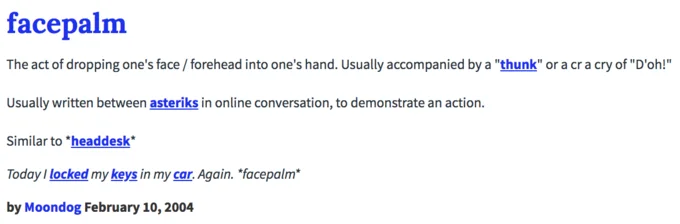
Facepalm transparently combines face and palm to name a physical gesture. Wikipedia reports early word records in Usenet posts from 1996, including the verb facepalmed; those examples document the word, not the broader online reaction convention. Know Your Meme identifies a February 10, 2004 Urban Dictionary entry as the earliest available online usage it found that describes writing *facepalm* between asterisks in conversation. That is a documented example, not proof of invention: the exact emergence of the online reaction sense is unknown. Separately, Know Your Meme connects the recognizable Picard reaction image to a Star Trek: The Next Generation scene and a 2007 YouTube identification of the gesture as a facepalm. The word later entered the Oxford English Dictionary, and the face-palm emoji joined Unicode 9.0 in 2016.[1]
How to use it
Facepalm is informal and may sound playful, self-deprecating, or sharply dismissive. Used about yourself, it can be self-deprecating; aimed at another person's comment or action, it can imply that you consider it foolish or naive. Context and relationship shape the tone, so the word alone does not make the reaction either joking or hostile.
The Picard image is one strand, not the whole meaning
The recognizable Picard reaction comes from a Star Trek: The Next Generation scene, and Know Your Meme notes a 2007 YouTube identification of it as a facepalm. The expression also works as an ordinary text reaction and appears in other online media.[1]
The gesture can be self-directed or aimed outward
Facepalm can respond to your own mistake or to someone else's perceived lapse. In the latter case it may suggest that you regard the action or remark as foolish; the word itself does not settle whether the tone is teasing or hostile.[1][2]
Facepalm versus head desk
A facepalm usually brings one or both hands to the face and is generally a single gesture. Head desk involves striking the forehead against a surface, typically in succession to emphasize the motion.[2]
Questions people ask
Is facepalm insulting?
Not inherently. It can be playful or self-mocking when you use it about your own error, but aimed at another person it may imply that their action or statement was foolish. Context and relationship affect whether it reads as teasing or hostile.[1][2]
Is facepalm the same as SMH?
No. SMH refers to shaking your head, while facepalm represents bringing a hand or hands to the face. Both can convey disapproval or disbelief, but they describe different gestures.[2]
Why is facepalm written between asterisks?
Asterisks can mark the word as an action in text. Know Your Meme identifies a 2004 Urban Dictionary entry that describes this convention in online conversation; that documented example does not establish when the convention began.[1]
Sources
- 1. Know Your Meme — FacepalmSupports: meaning, origin.
- 2. Wikipedia — FacepalmSupports: meaning, earliest documented use.
- 3. Cambridge Dictionary — FacepalmSupports: meaning, form.
- 4. Word Spy — facepalmSupports: form.