Okay, boomer (разновидность «Ok Boomer»)
/oh-KAY, BOO-mer/interjection · phrase
A terse reply that dismisses an old-fashioned or out-of-touch argument.
- #internet slang
- #generational politics
- #dismissive retorts
- #TikTok language
Meaning
“Okay, boomer” is a usually dismissive reply to someone whose argument seems old-fashioned, condescending, or out of touch. It can refer to an actual baby boomer, but “boomer” can also describe an attitude rather than a person’s age. The phrase may be playful between friends, though it often signals irritation, political criticism, or refusal to spend time answering a repetitive argument point by point.[4]
- 1. A terse conversation-ending response to an opinion perceived as outdated, patronizing, or disconnected from younger people’s circumstances.
- 2. A broader generational retort that can point to economic, environmental, and social frustrations associated with older generations, especially when the discussion concerns politics or the future.
- 3. A playful in-group reply among friends, where the exaggerated dismissal matters more than a serious claim about someone’s generation.
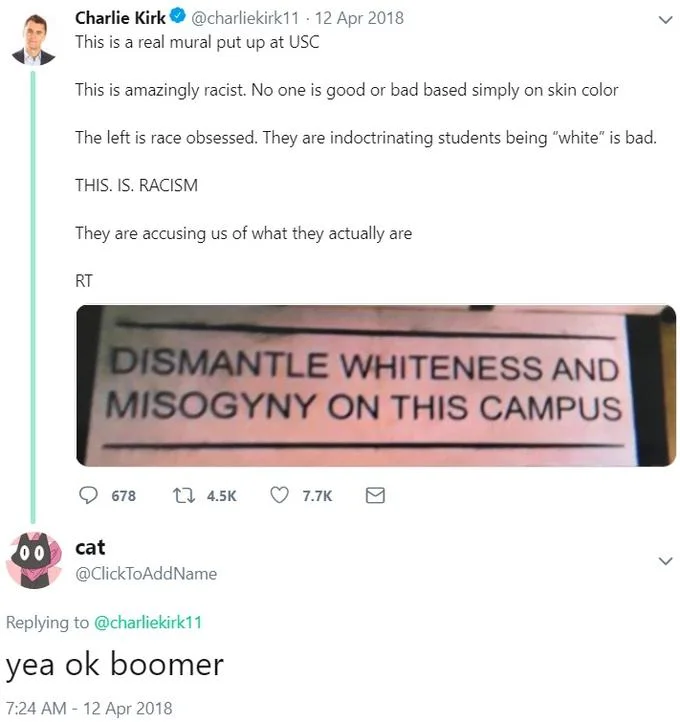
Examples
“You think rent is cheap everywhere? Okay, boomer.”
“Okay, boomer was easier than arguing through the same rant again.”
“I said Okay, boomer jokingly, but it still ended the conversation.”
“Calling her okay, boomer made no sense; she was criticizing an outdated policy.”
Origin and spread
The expression combines the conversational acknowledgment “okay” with “boomer,” short for baby boomer. In this retort, “okay” often sounds deliberately perfunctory: it declines to engage with the premise rather than affirming it. Know Your Meme reports an anonymous 4chan use dated September 3, 2015, while Vox independently traces early mentions to 4chan in 2015; both sources leave the exact origin unresolved. The phrase appeared in Reddit and Twitter uses later documented by Know Your Meme, began responding to politicians and criticism of younger generations in 2018, and spread much more widely in 2019 through memes, TikTok, music, and political discussion. Chlöe Swarbrick’s November 2019 New Zealand parliamentary use gave it a prominent public example. In her later Guardian account, she described that reply as an off-the-cuff response to heckling and as a symbol of exhaustion across generations facing worsening political, economic, and environmental problems. Some mainstream uses reduced the phrase to an age insult, while the reporting also describes a wider critique of generational condescension and material conditions.[1][4]
How to use it
The phrase is usually cutting, even when delivered casually. Use it when the point is to dismiss an argument or the pattern behind it, rather than when you simply want to identify someone’s age. Tone can make it teasing among friends or openly hostile in a political or workplace exchange.
The “okay” is often deliberately flat
Vox describes the phrase as a terse rejection of a circular generational argument. The surface acknowledgment can therefore function as a refusal to keep debating, rather than agreement with what came before.[4]
Why some people heard ageism
Vox reports that some baby boomers interpreted the meme mainly as ageism. The same account argues that this reading missed the broader criticism of condescension and the economic, environmental, and social anxieties behind some uses.[4]
The parliamentary example had a specific setting
Chlöe Swarbrick later explained that her New Zealand parliamentary use was an off-the-cuff response to heckling during a climate-change debate. Her account connected the moment with broader exhaustion across generations, rather than presenting it as a carefully planned slogan.[3]
Questions people ask
Does “Okay, boomer” always target a baby boomer?
No. The phrase can target an actual baby boomer, but it is also used for someone perceived as condescending, old-fashioned, or out of touch, regardless of their exact age. Know Your Meme describes it as applying to people who are perceived as old-fashioned.[1]
How is “Okay, boomer” different from “Ok Unc”?
Both are dismissive retorts aimed at someone seen as out of touch. “Okay, boomer” invokes the baby-boomer label and its generational associations, while the available Know Your Meme account describes “Ok Unc” as a similar later expression without establishing a more precise distinction.[1]
Why did the phrase spread so widely in 2019?
Know Your Meme documents extensive meme use across Instagram, iFunny, Reddit, and other networks during 2019, alongside remixes and TikTok circulation. Vox also connects its rapid mainstream traction that year with TikTok videos responding to older people’s complaints about younger generations.[1][4]
Sources
- 1. Know Your Meme — OK BoomerSupports: origin, earliest documented use.
- 2. Urban Dictionary — ok boomerSupports: form.
- 3. The Guardian — Chlöe Swarbrick’s account of her parliamentary comment
- 4. Vox — What does “OK boomer” mean?Supports: meaning, origin.