TMI
/tee-em-eye/initialism · interjection
TMI means “too much information” and reacts to details that feel more personal, graphic, irrelevant, or excessive than wanted.
- #internet slang
- #texting shorthand
- #conversation
- #oversharing
Meaning
TMI is short for “too much information.” Online, it is a reaction to details that feel more personal, graphic, irrelevant, or simply excessive than the listener or reader wanted. It can be a playful “I know more than I needed to,” a genuine signal to stop, or a self-aware label after your own overshare; it does not mean the information is false and is not inherently sexual.[2][4]
- 1. As a standalone reply or interjection, TMI signals that someone has shared more detail than the audience wanted, often because the detail is intimate, bodily, medical, or graphic.
- 2. As a self-applied tag, TMI can jokingly acknowledge an overshare. The full phrase can also refer to an excessive volume of information, even when the subject is not private.
Examples
“The recipe is fine, but I didn't need the full bathroom update. TMI.”
“TMI, but I have been wearing these socks for three days.”
“The report includes every draft and revision. TMI.”
Origin and spread
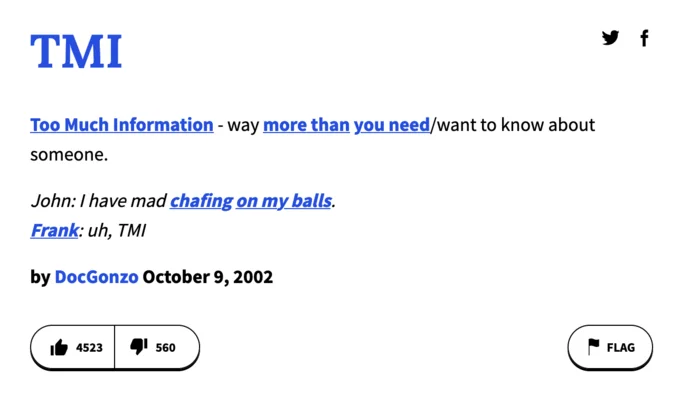
TMI is an initialism of “too much information.” Wiktionary reports that former Wall Street Journal reporter Joseph Checkler shortened the phrase around 1988, but that account is uncited in the available record, so it does not establish a creator or first use. Know Your Meme describes the term as popularized as internet slang in the 2000s; a 2007 NetLingo entry classifies it as text-message shorthand used across forums, chat, email, and blogs. The earliest contextually clear record located here is a user-submitted Urban Dictionary entry dated October 8, 2002, which defines TMI as more than someone needs or wants to know and gives a bodily-disclosure example. That documents the usage by 2002, not its invention.[1][3]
How to use it
TMI can land as affectionate teasing among friends, but in a serious conversation it may sound dismissive or embarrassing. Use it carefully when someone is sharing something vulnerable; a direct request to change the subject may be clearer and kinder.
Not only private information
TMI can also flag sheer volume or unnecessary detail, even when the subject is not intimate. Wiktionary records both the personal-information reaction and an excessive-information use.[2]
A documented self-applied tag
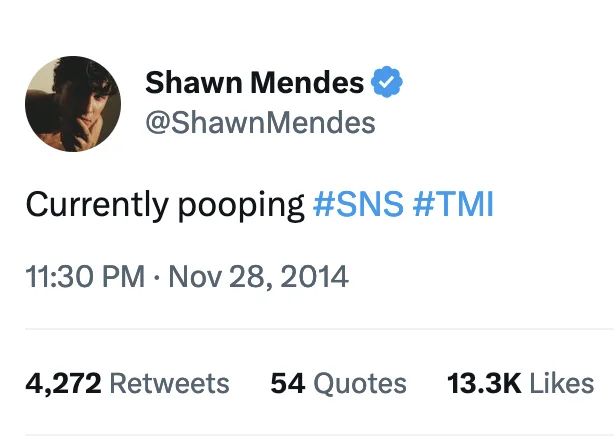
Know Your Meme reproduces a 2014 social-media post ending a bathroom update with #TMI. It illustrates the abbreviation used as a humorous label after the writer's own disclosure.[1]
Questions people ask
Is TMI always about sexual or bodily details?
No. Those details can prompt the reaction, but TMI can also refer to unnecessary detail or an amount of information that is hard to take in quickly.[2]
Sources
- 1. Know Your Meme — TMI / Too Much InformationSupports: origin.
- 2. Wiktionary — too much informationSupports: meaning, form.
- 3. NetLingo — TMISupports: origin.
- 4. Urban Dictionary — TMISupports: meaning, earliest documented use.