Zip Coding
/ZIP KOH-ding/noun · verb
Zip coding means either dating only nearby people or treating a relationship as active only when both partners are in the same place.
- #dating slang
- #local dating
- #relationship agreements
- #long-distance relationships
Meaning
Zip coding is a dating label that makes geography a condition of romance. It can mean limiting potential partners to a small local area, such as a tight dating-app radius. It can also mean treating a relationship as active only when both partners are in the same place, with permission to date or hook up with others while apart. The first meaning concerns who you date; the second concerns when you consider yourselves together. Neither the label nor physical distance establishes that both partners have agreed to the arrangement.[1][2][3]
- 1. Local dating: restricting matches or potential partners to people who live nearby. This may reflect convenience, though it can also involve filtering people by the perceived status of their neighborhood.
- 2. Location-dependent relationship: considering yourselves together when geographically close and single when apart. Whether this is an agreed arrangement or a breach of exclusivity depends on what both partners understand.
Examples
“I'm zip coding: a two-mile radius is enough for me.”
“We're zip coding: together on campus, single during breaks.”
“When you say zip coding, do you mean nearby dates or being single when you travel?”
“Our zip-coded relationship has agreed rules for dating other people while we're apart.”
Origin and spread
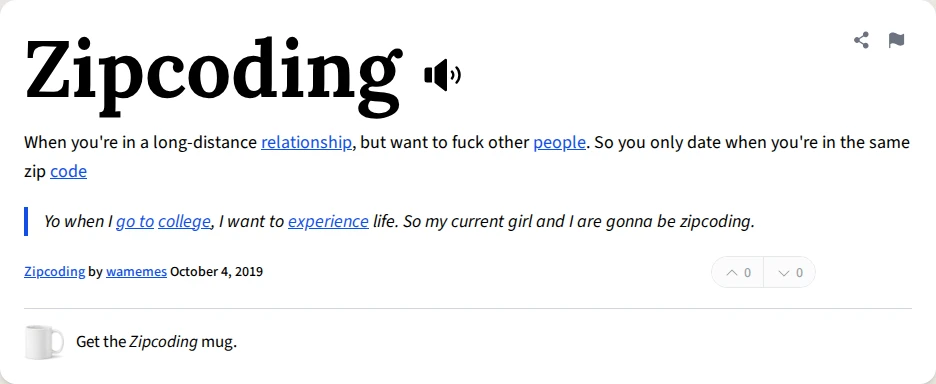
Earliest use not established. An Urban Dictionary entry credited to wamemes and dated October 4, 2019, documents the location-dependent relationship sense under the spelling “Zipcoding.” Its example imagines someone heading to college and agreeing with a partner to date only when they are in the same zip code. That records the expression and meaning by that date; it does not establish who coined it. In Cosmopolitan on October 9, 2025, Kayla Kibbe explained both the nearby-dating and location-dependent relationship meanings, describing zip coding as a trend that had reached her from TikTok. Her article identifies no originating video, so the TikTok connection is an attributed account of circulation. Moneycontrol's March 10, 2026 summary also records the local-dating meaning. These records do not establish which sense came first.[2]
How to use it
Specify the intended meaning: “zip coding with a small app radius” and “zip coding while we're away at college” describe different arrangements. The label can sound practical, critical or matter-of-fact depending on context. Dating nearby says nothing by itself about exclusivity. For a location-dependent relationship, state the agreement explicitly; calling it zip coding does not give someone permission to suspend a partner's understanding of exclusivity.
Convenience can become neighborhood snobbery
Cosmopolitan's Kayla Kibbe sees practical value in nearby dating because it can make regular contact easier and narrow an overwhelming pool of matches. Her criticism concerns filtering for wealthy or trendy neighborhoods: the same label can describe either manageable travel or status-based selection.[2]
Agreement separates an open arrangement from cheating
Kibbe compares the location-dependent version to an open relationship with geographic conditions. She considers it acceptable when everyone understands the terms, but calls it cheating when one partner privately treats distance as permission while the other expects continuing exclusivity.[2]
The 2025 explainer is not the expression's starting point
The Urban Dictionary entry dated October 4, 2019, already describes a relationship that applies only when partners share a location. Cosmopolitan's later TikTok framing therefore does not establish a 2025 invention date.[1][2]
Questions people ask
Does zip coding require matching postal codes?
The documented uses allow a broader geographic condition. Cosmopolitan discusses a small dating-app radius, living within a reasonable distance and being in the same general area. If you use the label, explain whether your boundary is a neighborhood, a radius, a campus or another agreed area.[2]
Is zip coding an alternative to a long-distance relationship?
The location-dependent sense can serve that purpose: partners consider themselves together locally and free to see others while separated. Cosmopolitan presents this as a possible short-term alternative to long-distance exclusivity, with agreement about the terms. The nearby-dating sense describes a different choice about finding partners.[2]
Did zip coding originate on TikTok?
That origin is not established. Kibbe described the trend as reaching her from TikTok in October 2025, but did not identify an originating post. A dated Urban Dictionary entry records the relationship-status meaning in 2019, showing that this sense was documented before that reporting.[2][1]
Sources
- 1. Urban Dictionary — Zipcoding, entry dated October 4, 2019Supports: meaning, earliest documented use.
- 2. Cosmopolitan — How Toxic Is the “Zip Coding” Dating Trend?Supports: meaning, origin.
- 3. Moneycontrol — 5 modern dating terms you need to know before swiping in 2026Supports: meaning.