Chalance
/shuh-LAHNS/noun
Chalance means openly showing care, enthusiasm and effort, especially toward someone you want to date, instead of playing it cool.
- #dating slang
- #emotional openness
- #friendship
- #wordplay
Meaning
Chalance is visible care or emotional investment: letting someone see that you are interested, enthusiastic and willing to make an effort. When someone wants chalance in a partner, they are asking for attention, thoughtful plans, clear communication and affection that shows in actions. The word playfully reverses nonchalance, particularly the habit of acting indifferent to seem cool. It also applies outside romance, including showing affection for friends or participating enthusiastically in public. Depending on context, it can praise that openness or gently tease someone for seeming very eager.[2][4]
- 1. In dating, openly expressed interest and consideration: making thoughtful plans, following through and paying attention to what matters to the other person.
- 2. More broadly, visible enthusiasm or vulnerability in friendship and social life. The same quality can be embraced as sincere or described self-consciously as trying too hard.
Examples
“I want some chalance: make a plan and follow through.”
“Remembering my favorite soup? That's the chalance I'm looking for.”
“My chalance is showing—I made a playlist for our next road trip.”
“Is bringing homemade cookies to the study group too much chalance?”
Origin and spread
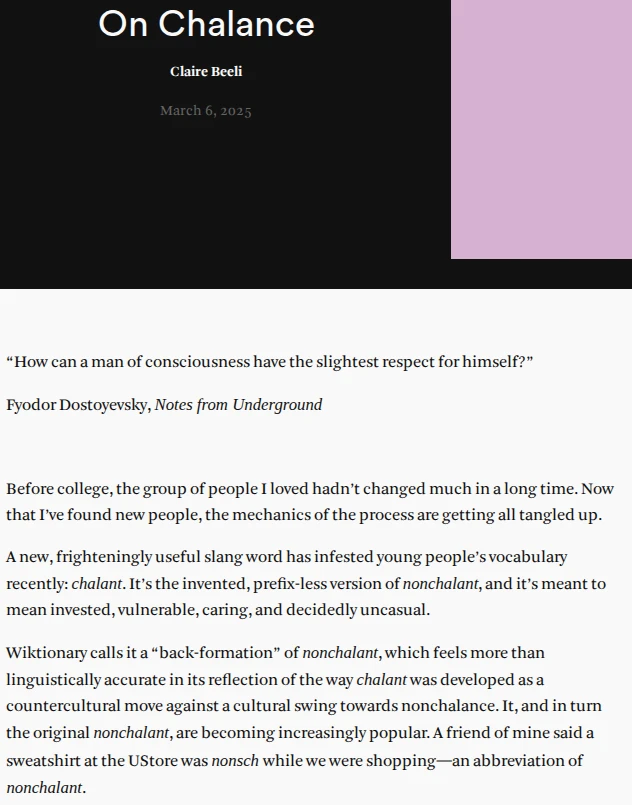
Earliest use not established. The word has an older history than its recent dating coverage: Wiktionary reproduces a 1961 Time quotation that jokes, “But their nonchalance is too earnest: the effect is chalance.” That is an older lexical precedent, rather than evidence of an uninterrupted path into internet slang. The formation is a humorous back-formation from nonchalance, treating non- as a removable negative prefix; chalant similarly reverses nonchalant. Contemporary slang is documented by March 6, 2025, when Claire Beeli's Nassau Weekly essay described chalant as invested, vulnerable and caring, discussing friendship, classroom participation and social-media self-consciousness. Hinge's September 24, 2025 report connected chalant with daters wanting visible effort, and Cosmopolitan's July 21, 2026 explainer described requests for chalance on dating profiles. These records establish use before 2026, but do not identify an inventor or originating platform.[1][3]
How to use it
Chalance is the noun; chalant is the related adjective. You can ask for more chalance or describe a thoughtful gesture as chalant. The tone is playful and informal. In dating, it often expresses approval, while a remark about being too chalant can acknowledge embarrassment about seeming eager. The term describes visible care rather than a fixed texting timetable or an attachment-style diagnosis. A calm manner alone does not tell you how much someone cares.
Why caring can feel embarrassing
In her Nassau Weekly essay, Claire Beeli describes feeling foolish after bringing a friend a scarf despite knowing the friend was allergic to wool. She uses the episode to explore the vulnerability of showing affection. That tension helps explain why someone might want chalance yet worry about appearing too chalant.[2]
Thoughtfulness depends on the person
Cosmopolitan quotes Hinge relationship expert Moe Ari Brown explaining that chalance means listening to what the other person actually values. In that account, a specific, thoughtful plan matters because it responds to the relationship; visible effort is more useful than simply making a grand gesture.[4]
Questions people ask
Does chalance mean replying immediately to every text?
No fixed response interval defines it. Cosmopolitan includes quick replies among examples of care, but its broader explanation emphasizes attention, listening and thoughtful action. Hinge's report likewise stresses consistent communication and making plans, rather than a universal texting deadline.[4][3]
Is chalance only about romance?
No. Beeli's March 2025 essay discusses affection between friends and describes classroom questions, group-chat participation and public enthusiasm as chalant. Dating is one prominent application of a broader idea: allowing other people to see that you care.[2]
Is being chalant attractive or embarrassing?
It can be framed either way. Cosmopolitan presents it positively as care and effort in dating, while Beeli describes the self-consciousness of appearing eager or vulnerable. Calling yourself too chalant can acknowledge that discomfort without withdrawing the affection itself.[4][2]
Sources
- 1. Wiktionary — chalanceSupports: origin, form.
- 2. Nassau Weekly — On ChalanceSupports: meaning, earliest documented use.
- 3. Hinge — The Most Desirable Partner of Cuffing Season is the PlannerSupports: origin.
- 4. Cosmopolitan — Being “Chalant” Is the Greenest Flag in Dating Right NowSupports: meaning.