Dry Texting
/dry TEKS-ting/noun
Dry texting means sending brief, flat replies that give the other person little to work with and leave them carrying the conversation.
- #texting etiquette
- #digital communication
- #relationship slang
Meaning
Dry texting is replying to messages in a terse, minimally engaging way: one-word answers, bare acknowledgments such as “lol,” or responses with no detail or question back. The defining feature is how little the reply contributes, rather than its length alone. “Good—how was yours?” is short but keeps an exchange moving; “good” may leave the other person doing all the work. Someone who regularly communicates this way can be called a dry texter. The label often expresses frustration at apparent lack of effort or enthusiasm, but it can also be a humorous description of your own texting habits. It describes how messages come across, not a proven motive behind them.[1][2][3][5][6]
- 1. As a criticism of an exchange: replies feel flat or give the recipient little to answer, so maintaining the conversation becomes one-sided.
- 2. As a description of a habitual style: someone keeps messages brief and functional, including with people they like. Calling yourself a dry texter can acknowledge that mismatch between written tone and in-person warmth.
Examples
“This is dry texting: I ask three questions and get a one-word reply.”
“Sorry for the dry texting today; my brain is still at work.”
“My dry texting makes me seem distant, but I could chat in person for hours.”
“You text first, then give me nothing to respond to—that’s dry texting.”
Origin and spread
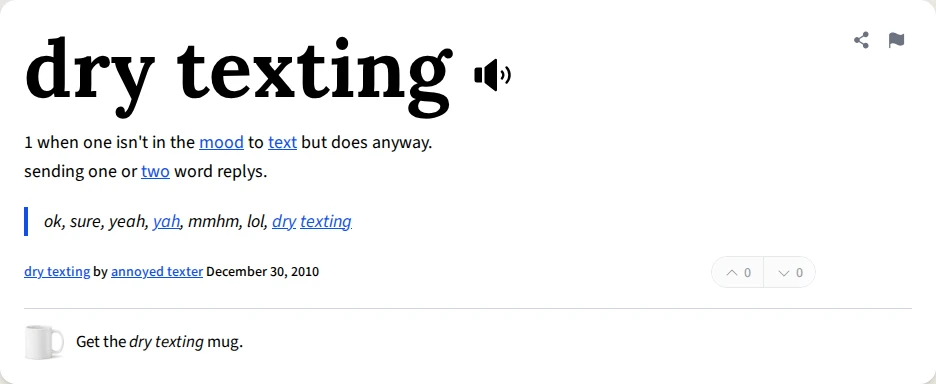
Earliest use not established. A readable Urban Dictionary entry attributed to “annoyed texter” displays the date December 30, 2010. It defines dry texting as texting despite not being in the mood and sending one- or two-word replies, with examples including “ok,” “sure,” and “yeah.” That documents the relevant sense by the date shown on the page; it does not identify a creator or originating community, and the displayed date is not an independently verified archival timestamp. By February 2023, the expression was receiving mainstream commentary. In British Vogue, Daisy Jones described herself and her partner as affectionate in person but brief and functional over text. Later that month, Guardian columnist Emma Beddington discussed dry texting among friends and family, including her own terse replies. Cambridge’s new-words blog featured the expression in November 2025. That was later recognition of an already documented term, rather than its beginning. These records show continuity in the core meaning while illustrating debate over whether brief messages reveal someone’s feelings.[4]
How to use it
Use dry texting for a reply pattern that contributes little to an exchange, rather than every short message. A quick answer to a practical question may be all that is needed. “You’re dry texting” can sound accusatory because it implies low effort; “I’m a dry texter” can be a light acknowledgment of your own style. The expression applies to friends and family as well as dating. Compare someone’s replies with their usual habits and the immediate context before treating them as evidence of rejection.
The same replies can provoke different interpretations
In a September 2023 Mumsnet thread, a poster was confused by a partner who initiated contact but then gave one-word replies after a disagreement. Respondents offered competing interpretations, including sulking and being busy with work. The poster later said this differed from his usual frequent messaging. Those reactions illustrate the ambiguity; they do not establish his motive.[5]
A dry texter can still be affectionate
British Vogue writer Daisy Jones describes herself and her partner as functional texters who are affectionate in person. Guardian columnist Emma Beddington likewise describes terse family exchanges and says occasional expansive messages feel especially welcome. These are personal accounts showing why a flat text need not reflect a cold relationship.[6][4]
Questions people ask
What can I add to a short reply to make it less dry?
Give the other person something specific to respond to: a detail, a relevant question, or both. Instead of only “good,” try “Good—finally finished my project. How was your day?” SwipeLexicon offers this as a practical rule of thumb, not a tested guarantee. The useful distinction is whether your reply opens another conversational turn.[2]
Does dry texting mean someone is losing interest?
It can suggest that, but the messages alone do not establish it. Cambridge explicitly treats disinterest as a possibility. In British Vogue, Daisy Jones distinguishes a consistently brief style from a sudden shift away from warm, detailed messages. A change gives you a reason to ask what is happening; it does not supply the answer.[1][6]
Sources
- 1. Cambridge Dictionary blog — New words, 17 November 2025Supports: meaning.
- 2. SwipeLexicon — Dry texting meaning: when it's a signal and how to stop doing itSupports: meaning.
- 3. Urban Dictionary — dry texting, including the entry dated December 30, 2010Supports: earliest documented use, meaning.
- 4. The Guardian — Emma Beddington on being a dry texterSupports: origin, form.
- 5. Mumsnet — Why would he text first and then give dry replies?Supports: meaning.
- 6. British Vogue — Take It From A Dry Texter: Short Messages Don’t Mean Someone Isn’t InterestedSupports: meaning.