Orbiting
/OR-bit-ing/noun · verb
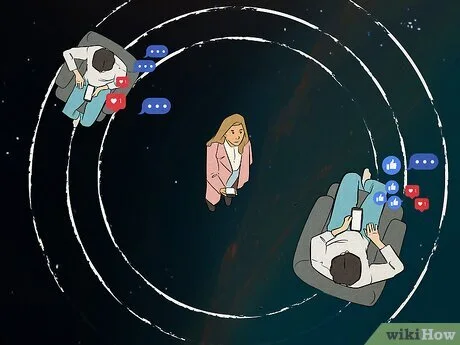
Orbiting means withdrawing from direct romantic communication while staying visibly present through social media views or occasional likes.
- #online dating
- #social media
- #post-breakup contact
- #dating slang
Meaning
Orbiting is the dating behavior of stopping direct communication with someone while continuing to show up around their social media. An ex, former date or romantic interest might ignore messages but keep appearing in Story viewer lists or occasionally liking posts. The defining feature is the gap between visible online attention and absent personal contact. Watching Stories after ignoring texts fits this pattern; watching the Stories of someone you still regularly talk to does not, by itself. The label describes observable behavior, so it does not establish that someone wants you back or is deliberately trying to manipulate you.[1][2][3][4]
- 1. After dating or a breakup: an ex or former date remains visible through Story views or occasional likes while no longer communicating directly.
- 2. During a developing romantic connection: someone pulls away or stops replying but continues watching your social media. This is the same pattern before an established relationship.
Examples
“My ex is orbiting me: every Story watched, every text ignored.”
“Is this orbiting? They stopped replying but still like my posts.”
“They're orbiting me, but I'm not treating a Story view as a request to get back together.”
Origin and spread
Earliest use not established. In reporting published on May 24, 2018, ABC News credited writer Anna Rose Iovine with naming the behavior after someone stopped answering her texts but continued watching her Instagram and Snapchat Stories and liking photos. ABC interviewed Iovine and pointed to her already-published Man Repeller essay, which it described as viral. That contemporary account documents her role in bringing the dating label to wider attention without establishing an absolute first use. The metaphor is someone staying in your orbit: close enough to remain visible, without directly reconnecting. Fortune revisited the term in 2024 through interviews with relationship coaches, and Cosmopolitan explained it again in 2026. Those later articles show continued use of a label already documented in 2018.[1]
How to use it
Use orbiting for the combination of withdrawn direct contact and continued visible social-media attention. Sources differ slightly about its boundaries: ABC News and Cosmopolitan include occasional likes, while coach Benjamin Camras's description in Fortune emphasizes passive viewing without likes, comments or DMs. The tone can be frustrated or bemused, but the word alone does not prove romantic interest, malice or manipulation. A recurring pattern gives the label more context than a single Story view.
Visible attention may not be an intentional signal
ABC News reports Iovine's account of a friend confronting someone who watched her Snapchat Stories without answering texts. His reported response was surprise that she could see his viewing. The anecdote illustrates a concrete misunderstanding: attention can be visible to the recipient even when the viewer does not realize it.[1]
The viewer list can become a checking loop
In Fortune, relationship coach Sabrina Zohar describes posting a Story, waiting to see whether a crush views it, and then feeling disappointed when no message follows. Her observation helps explain the frustration attached to the term: a visible view supplies another cue to interpret without resolving the silence.[2]
Ghosting and orbiting can happen together
Ghosting describes the withdrawal from direct contact; orbiting adds continued, noticeable social-media presence. Someone can therefore ghost your messages while orbiting your account. Orbiting can also follow an acknowledged breakup, so it does not require an unexplained disappearance.[1][3][4]
Questions people ask
Does orbiting mean they want to get back together?
Views and likes alone do not establish that. In Cosmopolitan, Diane Poole Heller explicitly cautions that watching Stories does not necessarily mean someone wants to reconcile. Curiosity, nostalgia or ambivalence are among the possibilities discussed there. A direct conversation provides clearer information than trying to decode a viewer list.[3]
Do likes count as orbiting, or only Story views?
Likes can count. ABC News's 2018 account includes watching Stories and liking photos, and Cosmopolitan also includes occasional likes. Benjamin Camras gives Fortune a narrower description centered on viewing without liking or commenting. Across these accounts, the consistent feature is continued digital presence after direct engagement stops.[1][2][3]
What can I do if someone's orbiting keeps bothering me?
Cosmopolitan's experts suggest focusing on how the continued presence affects you rather than decoding every interaction. Depending on the platform and the distance you want, options include muting, unfollowing, restricting or blocking. You do not need proof of a bad motive to set a boundary around access to your posts.[3]
Sources
- 1. ABC News — The latest social-media-linked dating trend: 'orbiting'Supports: meaning, origin, form.
- 2. Fortune — 'Orbiting' and dating-app disillusionmentSupports: meaning.
- 3. Cosmopolitan — What Is “Orbiting” in Dating?Supports: meaning.
- 4. wikiHow — Orbiting in Dating: What It Means & Why People Do ItSupports: meaning.