quiet cracking
/KWY-uht KRAK-ing/noun
Growing unhappiness at work that builds while an employee stays in the job.
- #workplace slang
- #employee morale
- #workplace surveys
Meaning
Quiet cracking is a workplace label for mounting unhappiness that can go unnoticed while an employee stays in their job. Someone may still hit their deadlines while feeling increasingly unsupported, disconnected or ready to leave.
- 1. A gradual loss of morale while continuing to work.
- 2. A description of concealed strain that may precede disengagement or a decision to leave.
Examples
“She used quiet cracking to describe months of carrying on while miserable.”
“The manager noticed quiet cracking only after two people asked to transfer.”
“Quiet cracking can hide behind a perfectly ordinary status update.”
“That survey asks about quiet cracking in teams that still meet their targets.”
Origin and spread
TalentLMS published a survey about quiet cracking in April 2025 and credits itself with introducing the label. Later workplace reporting, including RTÉ's comparison with quiet quitting, helped circulate it. The early evidence is a survey label and media discussion, so the phrase has no clinical threshold.
How to use it
Quiet cracking focuses on how work feels and how that feeling builds. Quiet quitting generally describes a decision to limit what you do to the duties of the job.
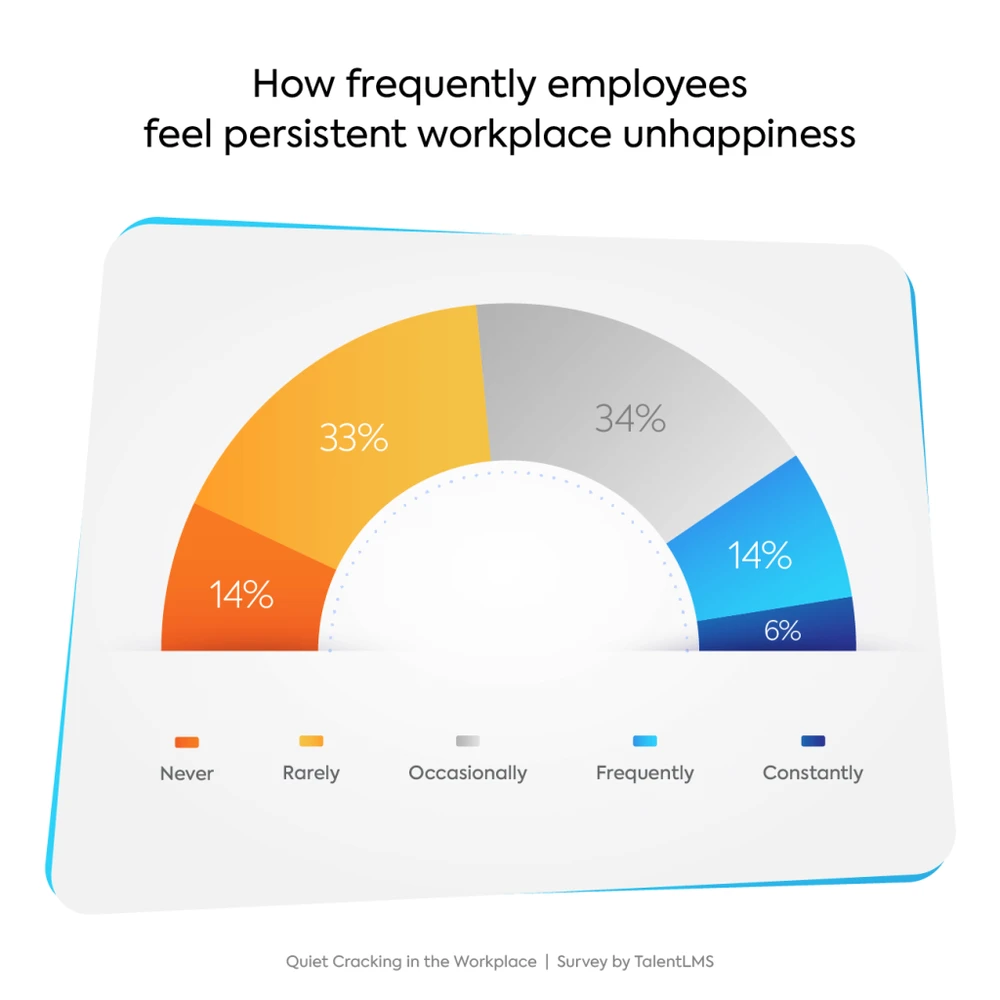
What the chart measures
The survey asked people how often they felt unhappy. Its distribution describes reported experience among respondents.[1]
The comparison with quiet quitting
RTÉ places the two labels side by side. Quiet cracking calls attention to mounting strain, which may precede any visible change in how someone works.[1][2]
Questions people ask
Can quiet cracking happen while performance looks fine?
Yes. The expression draws attention to deteriorating morale that may be hidden by routine performance.[1]
Does it refer to a decision to quit?
It describes mounting strain. A person can stay indefinitely and still describe their experience this way.[2]