Sephora Kids
/seh-FOR-uh kidz/plural noun
Sephora Kids labels children, especially preteens, drawn to prestige skincare and cosmetics, often with a mocking suggestion of demanding or disruptive shopping.
- #beauty culture
- #preteen skincare
- #TikTok trends
- #consumer stereotypes
Meaning
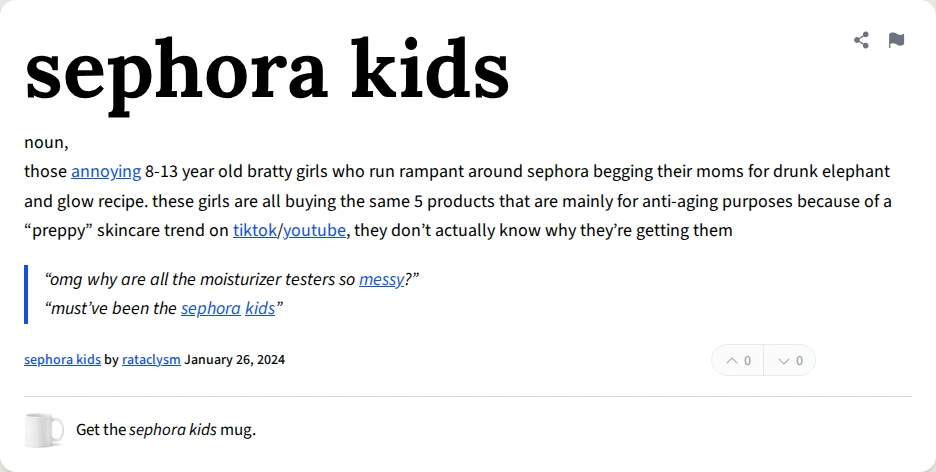
Sephora Kids is an internet label for children, especially preteens, who enthusiastically seek out prestige skincare and cosmetics associated with online beauty trends. It evokes expensive serums, Drunk Elephant products and influencer-style routines, including anti-ageing products marketed for older skin. In critical posts, the expression also carries a stereotype of demanding shoppers who leave testers messy or treat staff and other customers rudely. Those accusations are part of the label’s baggage, rather than facts about every child interested in beauty. The distinguishing idea is participation in this aspirational shopping culture; simply buying lip balm or visiting a cosmetics store does not establish it.[1][2][5]
- 1. Broad descriptive context: young beauty consumers interested in prestige brands, online product recommendations and elaborate skincare routines.
- 2. Critical or mocking context: the same label used to suggest entitlement, unsuitable purchases or disruptive behavior around store displays and testers.
Examples
“My sister is a Sephora kid now; her birthday list is all serums.”
“The Sephora Kids debate is about more than messy testers.”
“She loves beauty videos, but calling her a Sephora kid doesn't mean she's rude.”
“Our Sephora Kids conversation ended with a budget and a much shorter shopping list.”
Origin and spread
Earliest use not established. The expression was documented by 22 January 2024, when BBC reporting described TikTok and Instagram posts under #sephorakids complaining about young shoppers at Sephora and Ulta Beauty. Those posts linked messy displays and alleged rudeness with demand for Drunk Elephant and products containing retinol or exfoliating acids. The underlying shopping interest was already visible before that coverage: an October 2023 DC Urban Moms discussion began with a parent asking what Drunk Elephant products to buy for a tween, and Beauty Independent reported in December 2023 on the brand’s response to criticism of children using its products. Neither record establishes an earlier use of the expression. Beauty influencers and product marketing feature prominently in the BBC’s explanation of the trend’s spread. By September 2025, the Guardian described Sephora Kids as a catch-all for preteens’ attachment to high-end beauty stores and their products, while also reporting workers’ concerns about conduct and pressure to appear older.[3][4]
How to use it
The tone depends on context: Sephora Kids can describe a consumer trend, serve as a teasing nickname or become an insult. In complaints about testers or employees, it carries a stronger accusation of entitlement. Use care when applying it to an individual child, since enthusiasm for skincare does not demonstrate misconduct. The retailer’s name also works as shorthand for a wider beauty-shopping culture: the reporting includes Ulta and online purchases. Posting beauty content is not a requirement.
The stereotype is stronger than the basic label
The BBC reported social-media complaints about rude encounters and messy displays; the Guardian also used the expression more broadly for preteens’ attachment to prestige beauty. A reference to Sephora Kids may therefore describe a shopping interest or imply bad behavior. The surrounding sentence determines which claim is being made.[1][2]
Parents were negotiating the brand wish list before the 2024 coverage
In the October 2023 DC Urban Moms thread, the original poster wanted to indulge a tween’s Drunk Elephant request but questioned the need for products on already clear skin. The parent later favored lip balm, sunscreen or body lotion as a compromise. Another participant said their child accepted Bubble instead. These are individual accounts of balancing brand enthusiasm, cost and product choice.[3]
Questions people ask
Why are Drunk Elephant and retinol so closely associated with Sephora Kids?
The BBC’s January 2024 report connected complaints about young shoppers with Drunk Elephant and demand for retinol, exfoliating acids and other products traditionally aimed at older consumers. The distinction is between particular products, rather than an entire brand being suitable or unsuitable: Beauty Independent reported that Drunk Elephant advised teens and tweens to avoid its more potent acid and retinol products, while a dermatologist questioned some of its other recommendations too.[1][4]
Can someone be called a Sephora kid if they shop at Ulta or online?
Yes. The BBC discussed Sephora and Ulta together and quoted a marketing researcher describing tweens’ online purchases. In this label, Sephora stands for a wider culture of beauty shopping and product aspiration, so a purchase at the named retailer is not essential.[1]
Is a Sephora kid the same thing as a skinfluencer?
A skinfluencer creates skincare content for followers; a Sephora kid can simply watch that content and want the products. The BBC describes tween skinfluencers demonstrating products as one part of a broader market of young consumers. Having an audience or posting a routine is not required for the label.[1]
Sources
- 1. BBC — ‘Sephora kids’ and the booming business of beauty products for childrenSupports: earliest documented use, meaning.
- 2. The Guardian — Sephora workers on the rise of chaotic child shoppersSupports: meaning.
- 3. DC Urban Moms — ‘Drunk Elephant?’ parenting discussion, October 2023Supports: origin.
- 4. Beauty Independent — Drunk Elephant Says Many Of Its Products Are Designed For KidsSupports: origin.
- 5. Urban Dictionary — Sephora Kids submissionsSupports: meaning.